fav science cartoon

Unstrange Phenomena

Dennys: News Politics Comedy Science Arts & Food

Showing posts with label Astronomy and Space. Show all posts

27 January 2011

Cosmic Bloodhound: Hubble Telescope Finds Distant Ancient Galaxy?

Check out what Hubble has found in the primordial beginnings of our universe.  
Views to date: 10, 024.  Thank you!


From Denny:  The Hubble Telescope continues to range far into the universe, chasing the scent of the ancient galaxies, pointing the way for us to find. Astronomers are excited about the latest find. How often every day do you find an ancient galaxy? When your spouse asks you how your day was when you arrive home you get to say, ever so  nonchalantly, "Oh, we just discovered an ancient galaxy today that took its light over 13 billion years to get here just to say hello."

27 July 2010

Giant Asteroid Threatens Earth In 170 Years

*** Crank up the planet asteroid defense system because Earth is expecting an asteroid impact soon - by astronomical time.


An artist's impression of what an asteroid impact with Earth might look like - photo from Newscom

Hollywood Asteroid Destruction Movies

From Denny: And you wonder where Hollywood gets these scary ideas for their movies. There's a new study out suggesting Earth might get hit by a giant asteroid in 2182. So, folks, that gives us about 170 years and a number of generations to get our proverbial act together to figure out how to destroy it, derail it off a collision course or evacuate the planet. Of course, that's if it hits at all. I do wish these guys would make up their minds. Is the human race scheduled for extinction or isn't it?

Scientists, being the annoying beings they know how to be, they are alarmists while they are also double speaking us about how unlikely it is that this giant asteroid will slam into Earth. Don't you just want to chick slap these guys into another time zone for the way they jack up your emotions and then deflate them like some helium balloon?

The official glamorous name of this giant asteroid

What's this giant asteroid's name? It's a terribly exotic one: 1999 RQ36 and it sounds like something off a Formerly Known As Prince music album. So now fading rock stars are naming killer asteroids?

The odds of impact

Well, the Vulcan Spock look alikes in the science world have declared this giant asteroid only has a one in a 1,000 chance of truly smashing into Earth. Thanks, guys, I feel so reassured now. The co-author of the study, MarĂ­a Eugenia Sansaturio of the Universidad de Valladolid in Spain, says half of the risk calculated corresponds to what are potential impacts in the glorious year of 2182. Listen, folks, we still have to live past 2012...

Sansaturio and the study team said they employed mathematical models to determine the risk of this asteroid impacting Earth as far in the future as 2200. What they discovered from the model is there were two opportunities for this possible collision in 2182.

More about their research is detailed in the science journal Icarus.

How big is this asteroid?

Just how large is this giant asteroid? It measures about 1,837 feet across which is about 560 meters. The National Academy of Sciences says in a recent report that a space rock of this dimension could cause widespread devastation at the impact site. "Ya think?"

This giant asteroid has been tracked by scientists through as many as 290 observations and 13 radar surveys like a pack of FBI agents watching a house of prostitution. Yet there is still some uncertainty because of the small influence it gets from the gentle push of the so-called Yarkovsky effect.

The Yarkovsky Effect

What's the Yarkovsky effect? Glad you asked because I didn't know it either. Of course, it was named for a Russian engineer (I.O. Yarkovsky) who talked about this effect way back in 1900. He described how an asteroid gains momentum from thermal radiation that it emits from its night side. After several hundred years go by, this effect's influence on an asteroid's orbit could be monumental.

The erratic asteroid orbit makes it difficult to pin down odds

Back to the study team in Spain as they figured out that up until the year of 2060, Earth's chances of getting hit by this giant asteroid is minimal and downright remote. That's so comforting, guys. However, the odds start increasing by a magnitude of four by the year of 2080 because the the orbit of the asteroid brings it closer to hanging out near Earth.

Those scary odds of impact start dipping down as the asteroid moves away from Earth. Then those odds rise again in 2162 and 2182 as the asteroid's orbit swings back toward Earth. It's an erratic orbital dance and therefore difficult to know exactly the odds of impact. "The consequence of this complex dynamic is not just the likelihood of a comparatively large impact, but also that a realistic deflection procedure (path deviation) could only be made before the impact in 2080, and more easily, before 2060," Sansaturio said. "After 2080, it would be more difficult to deflect the asteroid." Read that as we are screwed on this planet if the mathematicians are correct.

"If this object had been discovered after 2080, the deflection would require a technology that is not currently available," Sansaturio said. "Therefore, this example suggests that impact monitoring, which up to date does not cover more than 80 or 100 years, may need to encompass more than one century. By expanding the time frame for potential impacts, researchers would potentially identify the most threatening space rocks with enough time to mount deflection campaigns that are both technologically and financially feasible," she said.

Tell your children's children what to expect or deal with asteroid now

And there you have it. Make sure to leave a journal for your descendants so they can be scared the hell out of their minds too. Meanwhile, I'm taking a trip to Area 51 to find me some aliens with asteroid busting technology. Being proactive is the way to go. Let's go blast some giant asteroid out of the sky!


Congress Proposes Commission to Study Asteroid Impact Threat

Fresh Spin on Solar Powered Asteroids

NASA Panel Calls for Asteroid Defense Office


*** THANKS for visiting, feel welcome to drop a comment or opinion, enjoy bookmarking this post on your favorite social site, a big shout out to awesome current subscribers – and if you are new to this blog, please subscribe in a reader or by email updates!

*** Come by for a visit and check out my other blogs:

The Social Poets - news, politics
The Soul Calendar - science, astronomy, psychology
Visual Insights - photos, art, music
Beautiful Illustrated Quotations - spiritual quotes, philosophy
Poems From A Spiritual Heart - poetry
The Healing Waters - health news
Dennys People Watching - people in the news
Dennys Food and Recipes
Dennys Funny Quotes - humor

22 March 2010

Moon Water: Order Up Your Cocktail Today


An artist's rendering of the Centaur upper stage rocket separating from its shepherding spacecraft, on its way to crashing into the moon's surface, as part of the LCROSS experiment testing for evidence of water ice. (AP Photo/NASA)

From Denny: Last year all of planet Earth was excited we found trace amounts of water on the moon. Visions of future moon colonies danced in our heads. Ever since that discovery, scientists have been pouring over the massive data returned by the probes sent to map the lunar surface. What did they find? There are actually different forms of water compounds on the moon.

Just when you thought water was just water... :) Turns out Moon water comes from different sources which accounts for the varying organic compounds each contains. So, when you next belly up to the bar at your favorite nightspot and order a Moon Cocktail make sure to ask for one of three kinds of Moon Water: "nearly pure ice, a fluffy mix of ice crystals and dirt or a thin layer of water that comes and goes across the surface." When drinking Moon water we have our gourmet choices. Evian and Perrier, move over, because Moon water is coming into the market and onto your grocery store shelves soon.

India's Chandrayaan-1 moon probe found frozen water in 40 craters. It was NASA's Lunar Crater Observation and Sensing Satellite (LCROSS) mission to slam into the moon. Brilliant, huh?! They wanted to test soil content from the resulting impact plume. From the initial impact they found water and hydroxyl - and also tiny bits of pure ice mixed in from the surface layer which is younger ice. Underneath this was a deeper layer of water released which scientists believe to be from a much earlier time period.

What compounds did they find in this ice? According to Paul Spudis, of Houston's Lunar and Planetary Institute, "That water contains more water ice, in addition to a variety of molecular compounds - sulfur dioxide (SO2), methanol (CH3OH), and diacetylene (H2C4). This layer, at least one-half-meter below the surface, is probably older than the ice we're finding on the surface."

Spudis speculates that "some surface water likely comes from bodies that have impacted the moon over the eons - comets, for example, which are primarily ice and that some water might have been formed on the moon. Protons in the solar wind can make small amounts of water continuously on the lunar surface by interacting with metal oxides in the rocks."

While you are waiting at the futuristic space station in your mind for your ride to the new Moon colony, remember that special Moon Cocktail that inspired you to be a space tourist. Just when scientists think they have nailed down what they think something to be, new information comes into their world and now ours to prove them wrong. Have you ever seen so many people so excited to realize there is more beyond their wildest hopes? Stay tuned; there is still more data to be examined and who knows what will turn up next to delight and amaze us.


*** THANKS for visiting, feel welcome to drop a comment or opinion, enjoy bookmarking this post on your favorite social site, a big shout out to awesome current subscribers – and if you are new to this blog, please subscribe in a reader or by email updates!

23 November 2009

Video: How Weird Would Earth Look with Saturns Rings?


From Denny: This was a curious video I ran across today on Digg. Someone decided to do an artist's rendering of what Earth might look like if we had the rings of Saturn. It's a bit disorienting, amusing and even eerily beautiful to see the images of various cities around the world with how the rings would look in their skyline.

If our night skies looked different all these centuries can you imagine how our religions and mythology stories might have taken a far different track from this astronomical influence?

Take a look at this wonderful video:


*** Thanks for visiting!

29 July 2009

Video: Too weird to be believed - a new planet in the solar system?

The New Solar SystemImage by Lexinatrix via Flickr

From Denny: While most of us already know about this "maybe planet" what you will find interesting is its relationship to the solar system at a 45 degree angle on the illustration that certainly caught my eye. It reminds me of a lost ball in high weeds. :) BBC always does an entertaining presentation.

"Astronomers have a massive breakthrough as they discover a weird and very bright extraordinary object in the far reaches of our solar system. Is it a planet? Is it a block of ice? Whatever it is, it's bigger than Pluto. Fascinating science video from BBC Horizon show 'Bye Bye Planet Pluto.'"


Reblog this post [with Zemanta]

29 June 2009

Astronomy Video 1 - Mysteries of Deep Space: To The Edge of Time

From Denny: These are actually 20 minute long episodes discussing what the Hubble Space Telescope has brought us in new information, exploring the revolution in astronomy. This one is the 1st of six videos, enjoy!


Reblog this post [with Zemanta]

28 June 2009

Astronomy Video: 1st Image of an Alien Planet

From Denny: The Hubble Telescope sure has delivered time and time again; what a treat!

23 June 2009

Astronomy: Meteorite Grains Divulge Earth's Cosmic Roots


From Denny: A short article from the folks over at Science Daily. It seems like every few years there comes along a group of scientists telling us the Universe is either older or younger than previously thought. Who said Nature's laws are written in stone? Our maybe it's just our understanding is in a fluid state...

Pair of meteorite grains from the Murchison meteoritePair of the grains Image via Wikipedia


Here's an excerpt:

"The interstellar stuff that became incorporated into the planets and life on Earth has younger cosmic roots than theories predict..."

"Heck and his colleagues examined 22 interstellar grains from the Murchison meteorite for their analysis. Dying sun-like stars flung the Murchison grains into space more than 4.5 billion years ago, before the birth of the solar system. Scientists know the grains formed outside the solar system because of their exotic composition."

For the rest of the article just click on the title link.

Reblog this post [with Zemanta]

09 April 2009

Astronomy Blog Review: Nite Sky Girl

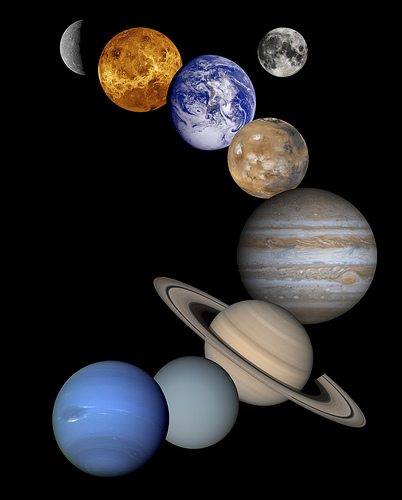
solar_systemImage by Royalty-free image collection via Flickr

Nite Sky Girl Blog for Beginner Astronomers!

When you first land on this blog it feels like you just got dropped out into space and are floating in the vast blue ocean of space viewing the planets and galaxy! Your fun greeting welcome when you arrive on this Canadian astronomer’s blog? “Astronomy rocks and so do you for orbiting my blog!”
Curious about a particular planet? There is a section for that where you can click on your favorite planet and find out the latest news. There are also sections to find out and view photos of comets and meteors. She has sky videos galore as well.

Especially for the beginner astronomer and kids is a question and answer area about space and astronomy you will enjoy. Most of the material is geared for older kids who can learn some of the astronomy specifics and vocabulary.

Not to be missed are her very readable extensive listings on the Astronomy News Page, as it is on a separate blog, go here.

If you need night sky help she answers email questions about what is the right telescope or binoculars for you.

Nite Sky Girl is a rocking blog you will enjoy visiting again and again!


Reblog this post [with Zemanta]
Blog Widget by LinkWithin

Ratings and Recommendations by outbrain