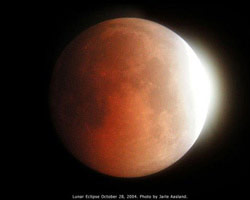
LUNAR ECLIPSE: Five moons, a composite image of a lunar eclipse, showing the path of the moon into and then out of earth's shadow. (Telescope Image). Source: Supplied
From Denny: The 10 December 2011 total lunar eclipse was the last total lunar eclipse to be seen until April 2014. At least we can view a partial lunar eclipse on 4 June 2012. It was reported to be an intense red, putting on quite a show in the sky. In fact, the type of red color was considered a rare treat.
Of course, when I went out to view it here in south Louisiana all I got was a completely cloudy sky. It's time for me to move up to higher ground, like the mountains. The Gulf Coast just doesn't cut it for proper skygazing. :)
From atmospheric scientist and eclipse expert Richard Keen of the University of Colorado:"During the lunar eclipse, most of the light illuminating the moon passes through the stratosphere, where it is reddened by scattering. If the stratosphere is loaded with dust from volcanic eruptions, the eclipse will be dark. A clear stratosphere, on the other hand, produces a brighter eclipse."
Visual Insights: Dennys Photo Gallery: 2011 Super Moon World Photos: "Yes, I've been on one of my visual vacations, tripping through the Flickr database for cool Super Moon photos. All of these photos were taken on 19 March 2011 for this year's Super Moon event all over the world. Usually, a Super Moon occurs about every 20 years. We are expecting another one in 2016. One photographer created a short video of his various shots and paired a great jazz love song with it. Enjoy these visual treats!"
Check out amazing lunar eclipse photos and video from Winter Solstice total lunar eclipse 2010. Views to date: 30, 158. Thank you!
From Denny: The most "recent" where the Winter Solstice and a total lunar eclipse occurred was on 21 Dec 1638. The next one won't be that long of a wait and will occur on 21 Dec 2094.
Yes, at our house, we went out into the night to gaze into the heavens to witness the celestial event. We parked ourselves on our back patio next to the small lake, bundled up under a thick quilt and enjoyed the clear skies an hour before the official time of the completed lunar eclipse. Good thing we went out to star gaze early as about 15 minutes before the official time of the event the sky completely clouded up with thick dark clouds and obscured all view of the starts and especially the moon.
We observed the Earth's shadow as it began to creep slowly over the moon's surface. As the shadow advanced the moon turned a pale coppery color like a dark blood red. At first it was an odd shade of reddish gray but then advanced to the coppery hue.
What was cool was how the moon really did appear to glow from within as one of these photos demonstrates. The moon remained covered with the Earth's shadow for about 30 minutes, deepening to the darker red known as the "blood moon." Then the cloud cover moved in like it was a curtain from a Las Vegas show saying "That's all, folks!" The air began to grow chilly, dropping in temperature by ten degrees quickly and the fog moved in off the lake.
We never did get to see the Earth's shadow move off the moon after the eclipse. It stayed cloudy all the next day and into the next night until late. When we finally did see the moon again it was huge and low in the sky shining with a stunning brilliance!
It was well worth the effort to get up in the middle of the night to view this cosmic event. We now have bragging rights at our house until 2094 when the next Winter Solstice total lunar eclipse occurs. :)
Check out the NASA Eclipse website. Make sure to stay tuned to the sky for a partial solar eclipse coming soon and to appear on 4 January 2011.
This photo is from 2008 and just spectacular so I just had to post it. :)
Another incredible time lapse video of the total lunar eclipse from KxbTV on YouTube, produced by Kareem Brown.
Check out the video from this 21 Dec 2010 event:
This video from YouTube user "peteherron" shows an amazingly smooth time lapse of the eclipse, compiled from shots with a still camera on a rotating telescope mount.
*** Photo of total lunar eclipse seen from the Washington Monument in Washington, D.C. on 21 Dec 2010
*** THANKS for visiting, feel welcome to drop a comment or opinion, enjoy bookmarking this post on your favorite social site, a big shout out to awesome current subscribers – and if you are new to this blog, please subscribe in a reader or by email updates!
*** Come by for a visit and check out my other blogs: